Wednesday, 27 January 2010

Modelling Stage- 27th January.

I've started modelling with zsphere. At the beginning I couldn't get the hips right. So I stopped working on that and started again this time following a digital tutors tutorial for modelling a super-hero with zspheres.

What I'll do is create a base mesh in which all my models will be made from. Zshperes allow you to re-pose your model so I can get this base one in to the difference statue poses.
I made a mistake with the hands, I posed the character before finishing everything (in zsphere mode) which means that I will have to remodel another hand. Alternatively I could start again.

I'll do that actually, it'd be easier, and save me less hassle. This is a mistake which I learnt from the character design project where I didn't start again and this had a detrimental effect on texturing, rigging and animating.

Here are some screenshots of the modelling stage.


As can be seen in this photo I will have to model another hand because a) I posed the character at the wrong time and b) I didn't have the symmetry tool on.
Group evaluation.
I think what went well for us as a group was that all of us had something to show. And we have communicated via email about what we had done. Diogo had some really good layout work for us to work with and at the end of our meeting we each got a copy of his work, so that we can work with it.

Another thing that worked well as a group is that we had a feedback session at the end (communication factor) of the meeting, so that we all know what we need to have done by next week.

Here are the notes I took for the group. I thought it prudent for somebody to take the minutes/notes of what is discussed that way we can remember what we talked about. See below.

We also allowed each of group member to voice their opinion and what could be improved.

26th January group discussion.

Diogo showed his work.

Diogo will give us his research and designs for reference.

Rocks and vegetation- for rocks the the vine will be making things decompose so that's where a lot of the rocks will come from.

Diogo had the idea of camera coming over mountain, so the market place is in a valley.

Buildings.

Buildings will have balconies that may have mini statues on them (kind of like small gargoyles).

Who is going to make the outpost buildings by the temple?- Kofi should be able to do this

Temple.

We have columns on outside. Structure on inside.

Once modelling done, start on texturing. Will use textures collected by himself.

No need to go high detail for interior of temple as we'll fade out at the end.

Statues.

- 4 statues, these will act as columns at the entrance.

- Stairs coming down from the temple, a large step with a statue on it (have an appropriate statue design for this), I was worried about it copying Troy

- Design some statues that will act as columns.

Vine.

Fairly dominant, to show strength, but not everywhere. So story wise the curse could have just taken over, but villagers ran away in fear.

Black Smith.

Established where Clym's black Smith should be. It's scale, in comparison to the established size of a human in our scene and a door frame of one of the buildings.

Swords and armour on front section of black smith and a curved building (semi-circle) at the back where the black smith would to fit in with the structure.

Black Smith originally designed to be opened plan, but doesn't fit in with the building style of environment. Stairs need to be scaled down as they are very chunky.

Black smith currently looks too important, it stands out too much. Diogo submitted the idea of the building originally meant for something else. Too free standing needs to fit in and be attached to the surrounding buildings.

Clym is happy to re-design the black smith

Camera.

Depending on camera work, we'll have to have poorer buildings on the outside. Also a courtyard with arches.

We have decided to go for individual shots instead of one long one. As we are going for individual shots we don't have to go for a really detailed matte painting we can just do a sky, and impressionistic mountains.

Camera angle of looking up at the building and in the background the mountain. Looking oppressive. Do print screens of the scene and work out the storyboard- this is to save time.

We'll then add notes in photoshop.

For next week.

Everyone should have started modelling and be well under way with their allocated tasks.

Today-

Finalised the layout of the scene in 3D. Went over designs & produced camera path storyboard.


Things to look up.

Batman- poison ivy.


During the set up of the camera, in Diogos' maya scene, Fahran and I had two different ideas for how the camera would behave. My idea was for the camera to be the character, so the camera would go through the scene but the aim is to have a horror genre to it. So for example, the audience would hear a plank of wood fall over (or something like that), and then the camera would quickly turn round to see what knocked it over. This way adding some variety to the camera and then have the camera appear somewhat cautious.

Fahrans idea was for the environment to be the character, so there wouldn't be any quick camera movements that kind of thing.

Fahran explained that my idea would break the flow of the camera movement. In the end, I made it clear that I didn't agree with this and Fahran opened it up to the group and the group didn't mind either way. I think, upon reflection, I'm glad I'm glad I left it with the fact that I disagreed and that was it, because we didn't waste much time and we got a storyboard idea finished with some great camera angles.

I've now had the idea of animating the camera in the style I wanted, that way I have a visual example of what I have in mind. This can also contribute to what I have done in this project.

If it does break the flow and it looks better with Fahrans' idea then I'll be happy with that. I do agree this would break the camera flow, but that was the idea, allowing it to have something different and more interesting. I do realise this idea needs more development and I'm happy for changes to be made.

Practicality wise.

I'll model my sculptures entirely in zbrush, as apposed to box-modelling in Maya and then export in to zbrush. I'll then retopologise the mesh in Zbrush. And then I'll create normal maps in Maya.

Tuesday, 26 January 2010

Monday, 25 January 2010

Review of the last week- 19th-26th January

The week before we arranged as a group (Diogo, Fahran, Kofi, Clym and myself) to meet on 12th

January, Diogo didn't turn up and he was guy who was assigned the layout and buildings designs, so one of our key players.

So near the end of the day I got us together to go over what our plan should be. We had to ask the questions of what happens if this becomes a consistent issue. So we made a contingency plan just in case Diogo didn't pull his weight.

So basically all of use would design some buildings, thereby spreading the weight.

I was set for this week to come up with a couple more statue concepts, some building designs (part of the contingency plan), some rotten fruit concepts and maybe start basic modelling of a statue.

Another thing that has come up was that I went away with the weekend, and I didn't get any work done which has put me back in terms of producing work. So because of this I haven't done any fruit, building concepts nor any basic modelling.

What I also haven't done is send out the notes we made, which has meant the other group members cannot use it. So, again I do not feel that I am utilising my time properly nor do I think I am producing enough work. Tasks are becoming increasingly longer to do and they are increasing in quantity which has meant that going away for the weekend and other things that are taking up my time are becoming more and more of a problem for production.

I do however, feel that I am relying more on my ical to do list method which has helped me be more disciplined. And this has also helped in me doing some work for my other project (compositing).

So because I lost last weekend 22nd-24th January. I will continue with designing the statues and then later today after college I will add the rotten material look and vines to my statue designs.

Then once I have done that I will do work for my compositing project.

Here are a couple more concepts pieces that I have done. In order to reduce the amount of modelling and increase efficiency I'm going duplicate some of the models so you have one either side of the entrance and the path leading to the fountain (see praying statue in previous blog entry for an example).

I altered face and neck because the neck was too long, after I had altered the dimensions of neck and face, mouth was in the wrong place.

Quick sketches in photoshop to get the over all pose and dimensions. I then started adding more detail. This I would classify as an alternative to 1st praying statue (please see below).


Friday, 22 January 2010

More Designs for the Statues.

After doing the research I pushed on in doing more drawings. I also borrowed two books on Greek sculpture, these have been incredibly helpful in terms of poses and what message the sculptures convey.

The books I borrowed were-

An Introduction to Greek Sculpture. John Barron. (1981) Athlone Press Ltd. London

Greek Sculpture. George Proffer Ltd. London. First printed 1961 by E. Desfosses Neogravure. Paris.

For all of the designs I started off with a silhouette and then added detail. I also used reference photos from my travels (particularly Budapest).

Here are the reference pictures from my holidays:

Other reference pictures I have used:


Here are the drawings (all done in Photoshop).


-------------------------------------------

-------------------------------------------

------------------------------------------

------------------------------------------

-----------------------------------------------
This is one of my favourite designs so far. I wanted at least one statue to convey submission/reverance or some form of act of worship for their gods. Especially as a temple is in close proximity to this market place.
-----------------------------------------------

I had a story idea of an animal giving birth to a human or a god in the form of a human. I spoke with fahran about what sort of animals to use as the animal gods and he said I should use big and strong animals. So I chose a hippo with a god coming out of it's mouth.


Concept design to illustrate the war that broke out between the animal gods and Zeus and his group of gods. Here I wanted the bull or minotaur (who leads the animal gods) having Zeus at his mercy. This will be one of the statues that I definitely want to model.

Sunday, 17 January 2010

Statue Design Stage.

So far I have done a couple of designs. Ideally I would like to have 6 designs but have variations of each, in order to show development.

Evaluation of myself.
I don't think I have planned nor spent my time well this week in order to have enough designs to show development and ready to be chosen for modelling for the following week. On the other hand this could be to do with the fact that we as a group haven't thought through the design stage properly. However the group did put in a another week for modelling as a back up which I could use for the design stage if worse comes to worse.

I think something that I have improved upon is being less precious over my work. I found that I became less precious over my work when I switched from pencil and paper to working in Photoshop.

Here are my designs so far.

I'm really happy with the top two because the proportions are accurate, I had an attempt at lighting, and it has that finished look to it. I particularly like the dotted detail on the shield which helps complete the drawing. For the second one I like the tones of yellow and the detail on the face helps humanize the statue and I didn't expect it to be so effective.
-------------
I have done a little more research on the Greek God Apollo, originally to find reference pictures. Instead I found some more information, which was sourced from Homer. I was wanting to find some different poses as apposed to just him holding his arm out in front of him (see picture above).

His attributes are the omphalos, lyre, bow and arrows, laurel, hawk, raven or crow, swan, fawn, roe, snake, mouse, grasshopper, and griffin. The attribute that caught my eye in particular was the bow and arrow.
source: Apollo - Who Is the Greek God Apollo. Available at: http://ancienthistory.about.com/cs/grecoromanmyth1/p/Apollo.htm [Accessed January 17, 2010].
I also wanted to collect some more reference pictures
. So here they are:


The pixologic site was recommended to me (http://www.pixologic.com/zbrush/gallery/) there are some great reference images.

Saturday, 16 January 2010

Idea Generation Stage.

So far I've been researching poses for the statues and how to get a good sense of weight as some of these statues will show some form of struggle or fight, so I want to get that right.

So I started looking around-

I've looked at pictures from Troy, and I've got some photos which have been quite helpful. See below.


My deadline is to have 6 finalized designs by Tuesday 19th January. In time for the modelling stage.

Here are some the drawings of my statue designs:


Here I'm mapping out on paper my thoughts as to the poses, not the actual bodily features that kind of thing (see evaluation of myself). Particularly with the right page, there isn't enough evidence of weight, which is something that I have been struggling with.


Again, attempting to show the force around the shoulder and back area as well as the front leg (leg closest to pitch fork). My idea behind this was to have the greek god Posiedon standing over his kill with his pitchfork stabbed in to his enemy. I don't feel that this drawing shows enough dynamic force and the fact that the drawing is disproportionate doesn't help either.

Throughout this time I was using The Human Figure in Motion by Edward Muybridge and Anatomy Drawing School by Andras Szunyoghy and Gyorgy Feher. i struggled with Muybridges book because they weren't the exact poses I was after. Anatomy Drawing School was useful because it helped me identify the muscle shape and their locations.


Again trying to get weight and following a digital tutors tutorial on drawing legs. The lesson was about starting off with primitive shapes and then building off on the top of that.
------------------
I've been giving the story to our environment some more thought and in order to fit in to the rotten and grungy textury theme.

Here's the storyline:

The Greek god Apollo, was unhappy with the worship he was receiving from this town. So he let loose a disease in the form of a vine. This vine would latch on to anything, and releases a toxin. For organic material, such as fruit, veg and fish it would make it go rancid and then rotten. Hard surface materials like buildings and statues it makes the material crumble and fragile, thereby affecting it's structural integrity.
This "curse" as the towns people have called it, is believed to install fear in to the population and for Apollo to receive the worship he desires.

From this story, in my drawings I'll add the vines on so that it can be clearly seen what I have in mind.
-----------------
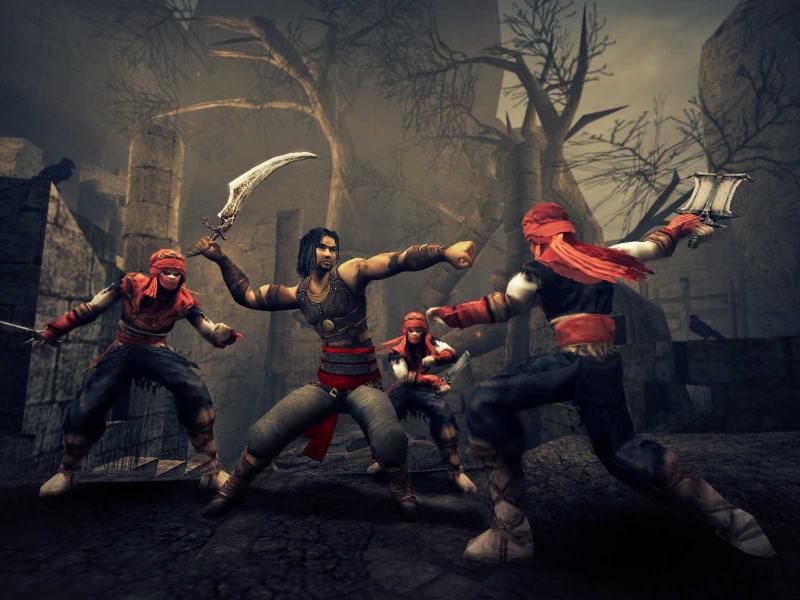
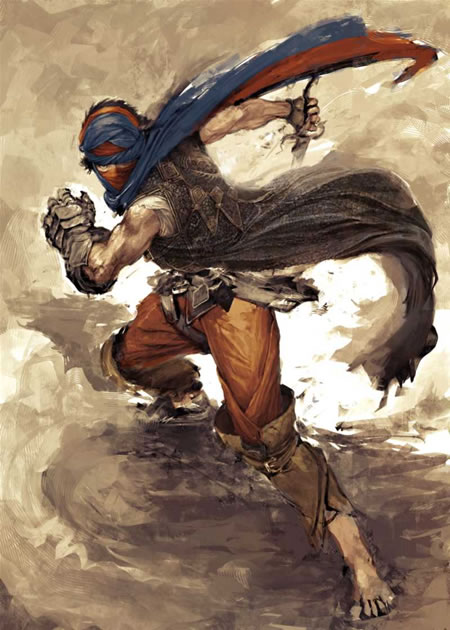
I've also started looking at the art of Prince of Persia. Some really inspiring art work. Particularly for textures.


What I like about this picture is that you can see the brushes and brush strokes they have used on this painting. I can see where the light is coming from and it's affect on the environment that this prince is in.


I like the dirt and darkness of the textures and the whole mood of the scene. I will use this on my concepts for the statues and storyboard.


I like the camera angle, architecture, the pots on the floor, sephia hue to the whole picture and the lighting washes out sections of the objects here which contributes to the mood.


Clear sign of weight and force here. I am realising now that I am going to have to exaggerate my drawings in order to show force and weight. I also like the pose, defensive and a good reference for statue poses. Colours are really nice and fit in to our colour scheme. What I also like, is this patchy style to the background. Also the pose allows your eye to follow up the princes body leading to the upper body and face, which has more detail than the rest of the painting.

Evaluation of myself.
I think I am being too cautious at the moment and I need to have my own reference photos of me in those poses that way I have research taylored to my needs.

I also need to do quicker drawings, rough stick figures and silhouettes, not caring about detail. This way I can have many designs so that I can have a choice on what to go for.

Thursday, 14 January 2010

Research and Idea Generation.

So far we have debated what kind of layout we're having and come up with a final layout. What I like about working with this group is that we let each other voice their opinion. We have also been very efficient in finding out where we want to specialise and what we're interested in. In addition writing a production time table both group and individual.

We first did the group one and then we mapped out the individual ones around the group production timetable. This has helped me plan my time around my other project. I have also found using ical on my mac has been a tremendous help in planning out my time and setting the option of it opening when ever my mac is switched on. It serves as a useful reminder on how much time I have allocated to each task for the day.

Group Production Schedule.
4th January Brief
12th January Research and Designs Layout of scene and story.
19th January Develop designs Camera Work and Storyboard.
26th January modelling and texturing
2nd February modelling and texturing
9th February modelling and texturing (backup)
16/02/10 lighting, dynamics rendering
23/02/10 compositing
2nd March (backup) compositing/rendering
5th March Hand-in

My individual Production Schedule.

Keith.
4th January- Brief
12th January- Research, Designs and story
19th January- Research and Designs and storyboard
26th January- modelling and texturing
2nd February- modelling and texturing
9th February- (backup) modelling and texturing statues. if done- design and model a building.
16/02/10- Rendering
23/02/10- compositing
2nd March- Hand-in

Review of 12th January 2010.
We as a group decided that for today we would swap research pictures, have a discussion with the tutor about the fact that we would like to work on our own idea rather than collaborate with the IDEAS degree.
As we were discussing the tasks that would be involved in order to write up a production schedule, we realised more and more that, particularly for Clym, the dynamics, was too ambitious. So we decided in order to be efficient, we should cut out things so: water and wind dynamics will not be used. Cloth and flame simulation will still be used for the market stalls and torches.

We had a new group member, called Diogo, which was great. He really helped out with the visualisation of our ideas in terms of layout. Everybody had their say and creative input in terms of what should go where. So at the end of the day we had a floor plan and a side profile of what our environment would look like.

We were advised to just focus on the market and then if we had time we would focus on the temple. This way we would have something done to a high standard and look finished.

One of the things that we struggled with was how to tell a story through the environment. Jared (tutor) really helped us out with this, and at the end of the day we decided having some form of sickness which makes the environment go rotten and fall apart.
I had the idea that Apollo, who is the greek god of healing and prophecy is also capable of producing great sicknesses, so we could play off of that as a story for the environment.

Camera movements wise:
I had the idea it could be like zelda, the camera would go up to a sign or a statue and then a speech box comes up with what the greek writing is saying, and then tell a story through the signs. However the group agreed that this would break up the flow of the story.

Make it like a scary movie where the town is deserted- this idea has yet to be debated.

What we also did was finalise the story. We chose 5th century BC because that was when the portraiture became a trend and the faces could be recognised as individuals.

Background of this city.

5th Century BC, there lived a civilised people in an average sized city who worshipped a multitude of gods. These gods would then pass on the peoples worship to The Gold Crest, in which is believed be the source of all life and wisdom. They believe the animals came first, then a millennia later Zeus and his realm. The human race was last to be created.

These animals oppressed their younger sibling gods and forced Zeus and his realm of gods to Earth. Where they were forced to build huge temples in the animals image, these temples could be built up to grand sizes of 100 acres. The animals made the promise that once done, Zeus and his council could ascend back to the status of gods.

A millennia had passed and Zeus and his council finished the work that they were forced to do. But the animal gods didn't keep their word, war broke out between the sibling gods.

With the desire for peace, between these races of gods, to prevent the loss of human life, they declared that no more war would happen. And with this peace agreement, the miracle of human life appeared in the form of a great civilisation.

Alternative- a fragile peace agreement was made between these two realms of gods. Each realm created their own civilisation of human beings, with different colour pigment and different culture. The animal gods brought up their human civilisation as oppressors and a superiority attitude, whilst the trauma of oppression spread to Zeus civilisation and so had a history of feeling inferior to the other civilisation.

Zues and his counsel brought up their civilisation with love and care, and wanted loving worship from man.

Whereas the animal gods commanded fearful worship and regular human sacrifices, to quench the animal gods thirst for blood. This is believed to prevent further war. They also encouraged a hateful and superior attitude against their neighbours.

What made this group work well was that if an important decision needed to be made, we checked to see if it was ok with everybody. We each had a clearly defined role suited to our specialty and that all tasks were assigned to members of the group.

I find that I work well in this type of group because I don't feel that anybody is dominating. On top of that, this is something that I find really enjoyable and fascinating, with researching Greek gods and architecture, I find this appealing and because of this I am learning alot.

Saturday, 9 January 2010

Research stage.

After we assigned roles to each other, I started gathering my holiday photos that my family have gone on, as this is where a lot of my research has come from in terms of image reference.

My role in this project is modelling statues of the environment and what I'm interested in developing is- texturing.

So far I have come up with some story-lines off the top of my head with out doing much research. What I intend on doing is, the historical research I have collected and I will use work contextualize my story ideas and see if it will head in any new directions.

Here are my story ideas:

Background of this city.

Around ????? years ago there lived a civilised people in an average sized city who worshipped a multitude of gods. These gods would then pass on the peoples worship to The Gold Crest, in which is believed be the source of all life and wisdom. They believe the animals came first, then a millennia later Zeus and his realm. The human race was last to be created.

These animals oppressed their younger sibling gods and forced Zeus and his realm of gods to Earth. Where they were forced to build huge temples in the animals image, these temples could be built up to grand sizes of 100 acres. The animals made the promise that once done, Zeus and his council could ascend back to the status of gods.

A millennia had passed and Zeus and his council finished the work that they were forced to do. But the animal gods didn't keep their word, war broke out between the sibling gods.

With the desire for peace between these races of gods to prevent the loss of human life, they declared that no more war would happen. And with this peace agreement, the miracle of human life appeared in the form of a great civilisation.

Alternative- a fragile peace agreement was made between these two realms of gods. Each realm created their own civilisation of human beings, with different colour pigment and different culture. The animal gods brought up their human civilisation as oppressors and a superiority attitude, whilst the trauma of oppression spread to Zeus civilisation and so had a history of feeling inferior to the other civilisation.

Zues and his counsel brought up their civilisation with love and care, and wanted loving worship from man.
Whereas the animal gods commanded fearful worship and regular human sacrifices, to quench the animal gods thirst for blood. This is believed to prevent further war. They also encouraged a hateful and superior attitude against their neighbours.

Story idea 2.
could be where various old religions- Egyptian and Greek gods could have originated from. So the main temple would have a blend of these civilisations architecture.

Story idea 3.
millions of years ago of years, there lived an advanced civilisation. Not advanced in physical, chemical or biological science or technology but in sociology.
Dark-
Could manipulate other cities to their own personal benefit. If a people declared war on these manipulative people then they would infiltrate their armies and gain influence among the armies and get a grip on them to an extent where this army would- kill each other. Or join forces with the manipulative city.
Light-
Used it to benefit their allies, so helped them resolve conflicts, negotiate business deals with other cities. Because of the helping nature, that nations that were helped by them, presented these people a gift- building a city for them, with a blend and combination of architecture from Greek and Egyptian culture and heritage.

In order to enrich my story ideas, or come up with new and better ideas I started researching Ottoman Empire, Greek architecture, history and religion.

I feel that I have learnt a lot about these areas. Please see below.

Otterman Army.

- The Ottomans arose from the obscure reaches of Anatolia in the west of Turkey.

- Called the Oghuz. They had come, primarily, as settlers during the reign of the Seljuks in Turkey (1098-1308); the Anatolian frontier was largely hostile to Islam.

- The Ottomans soon ruled a small military state in western Anatolia by 1300, about the time the Seljuk state was crumbling apart. This small state was in conflict with several other small Muslim states, each preying on the other for territory.

- By 1400, [they extended] their influence, over much of Anatolia and even into Byzantine territory in eastern Europe: Macedonia and Bulgaria.

- Constantinople resisted every siege and every invasion that the Muslims threw at them.

- The Ottomans, however, wanted to break this cycle. The seizure of Constantinople represented a powerful symbol of Ottoman power, but it would make the Ottomans master of east-west trade.

- 1453, Sultan Mehmed (1451-1481), who was named “The Conqueror” took this last remnant of Byzantium and renamed it, Istanbul. From that point onwards, Otterman Europe remained in Istanbul. This then became 'one of the most cultured cities of the early modern world'.

- The Ottomans inherited a rich mixture of political traditions from vastly disparate ethnic groups: Turks, Persians, Mongols, Mesopotamian and Islam. [This list here will be another stepping stone in my research, even though it is political influences, I would still like this to have an influence on architecture and sculpture].

- The Ottoman state, like the Turkish, Mongol, and Mesopotamian states rested on a principle of absolute authority in the monarch.

- Ottomans set up a number of practices and institutions in the central government surrounding the Sultan. The first was the establishment of a bureaucracy drawn from the Sultan's inner circle. This bureaucracy in turn controlled local governments.

Other institutions and political practices were:

- Observance of government : The Sultan's job was primarily to keep a watch on all the officials. In some cases, this observance of government involved the personal involvement of the Sultan. He would sometimes observe in secret the proceedings of the Diwan, the central advisory group to the sultan. Sultan was required to tour local governments in disguise to ensure that magistrates and justices were operating justly.

- For the most part, the Sultan monitored local officials through a vast, complex, and elaborate system of spies who would report back to the central bureaucracy. The intelligence gathering system in the Ottoman Empire was the best in the world, until the twentieth century.

- Public agents and officials that abused their power and the peasantry were subjected to a special jurisdiction called the Siyasa. Which were a set of severe punishments imposed by the Sultan on corrupt officials.

- In the siyasa system, the most severe crimes involved illegal taxation or forced labour of the peasantry, staying in their homes without permission or billeting troops without permission, and requiring peasants against their will to provide food for them or for soldiers.

Members of Ottoman society could approach the Imperial Council with grievances against government officials; these official petitions were called ard-i mahdar and were always treated with the utmost seriousness. If the Imperial Council ruled against the officials, they would often be subjected to the siyasa.

-Centralised Government...available to each and every citizen of the Empire.

- All Ottoman wars of the conquest in the sixteenth century were assiduously planned years in advance.

- Government would lay up stores of supplies all along the campaign route so that the armies could feed themselves

- Ottoman conquerors believed that no conquest could stand without the goodwill. So military campaigns were remarkably fair and easy on the average person.

The Ottermans appeared to operate similar to both, the Turkish and Mongol, [in a monarchy]- both the Turkish and Mongol peoples believed that the crown fell to the most worthy inheritor.

- Each individual in the hereditary line, brothers and sons, were equally entitled to the crown.

- This meant that successions were almost always major struggles among contending parties.

- Once a Sultan had assumed the throne, all his brothers were executed as well as all their sons

- [This guaranteed] no future wars or struggles.

- Ottoman state saw a succession of mad Sultans and the corresponding increase in power of a corrupt bureaucracy.

- Ottomans followed the old Turkish and Mongol tradition- Sultan's lands to be a joint possession of the Sultan's family [and] conquered lands were considered the private property of the Sultan.

- Sultan was regarded as personally responsible for every government decision, in reality the government was run by a large bureaucracy.

- The Sultan was constrained by these rules.

From this research I was starting to really like the Ottoman Empire as i felt that they fitted in with the civilised and socially advanced civilisation of my story idea.

[It appears that the Otterman Empire had a lot of similarities to todays politics i.e. something that is good in theory, but, when in reality a lot of it is corrupt and a load of empty words meant to convince people to vote for their party.]

I had been doing silhouette drawings of the city to get the layout, composition and camera angles right. Mapping out my thoughts as i find this gets rid of preconceived ideas and allows me focus. During my research, I hadn't taken in to account capital punishment nor government buildings. So with a centralised government, this could mean an easy access building, with my current layouts. So this will be incorporated in my layout designs.

After doing Ottomen research and finding that there was a Pre-Islamic and Post-Islamic I decided to focus on the post-islamic side for it's architecture. A fact about the Ottoman Empire which I found incredible, it lasted late in to the 20th century.

The idea behind the research section in our group is to collect anything we find inspiring and that could be used as a reference. I found this both liberating and enjoyable because it felt like I didn't have any restraints with research. Here are some research pictures that I have collected from the internet:


Something that I was wanting to get in my designs was a good sense of perspective. In this case I see a one point perspective, which is the path leading up to the mosque. I also liked the dome shape, or water droplet shape on top of the mosque. This is one of the things that stand out in Islamic architecture and it was something I wanted to incorporate in to some of the defense building designs.


The first reason why I chose this photo was because of the colours, I loved the mixture between the gold of the object in the middle of the mosque and the selection of greens on the ceiling mixed with the light refractions of the chandelier. I also really liked the art-nouveau decoration which is very pre-dominant in this interior design.
Another reason why I chose this photo was because the people in this scene are interacting the environment, which is a criteria that has been emphasized in this unit and it is something that I want to understand better.


Again I was looking at the shape and decorations on islamic architecture in order to put in to my designs, because I was after some form of islamic influence in some of my designs.


In here I loved the decor of the walls, and the variety of textures. I found this photo cool, and could be potentially used in the design stage. The main application of this would be in the temple design.

After I had researched Ottoman empire, I decided to research some of the Greek gods and the history of sculpture. See if I can some how incorporate it in to my designs.

Here are some photos from my trip to Athens:


This was the view from a restaurant roof top. The culture there is very different when it comes to the eating and of serving food. The duration between each course is very long, what feels like 20 minutes sitting at a table waiting for your next course to come.

This photo was taken using a 20-55mm canon lens. I had the shutter speed quite high because at this time, it was late afternoon so the sun was almost setting. It also allowed me to get the shadows from the glasses and cloth.

Again I was looking for inspiration and the use of perspective and composition. I found this to be a good source of reference for my silhouette drawings. So in the picture above, you have the railings coming together, which then leads your eye to, I think, is a church on (what I know) is a very tall hill.


This is a photo of the Acropolis, from my hotel room. I was fortunate enough to have this on one side of my view on the balcony and then a view of Athens where you can watch the sun setting.

This photo has got some useful reference in it. 1- principle of what is closer to you is bigger (and your eye can pick up more detail) and objects that are further away, appear less detailed. This is principle which is also useful for rendering a 3D environment have the objects that are furthest away from the camera have a lower polycount and smaller texture resolution. I also found this principle helpful in my silhouette drawings.

Here's my research of Greek sculpture and the ancient gods so far.

6th Century BCE, 100 years before classical Greek sculpture took place. The Greeks had pretty much perfected sculpture of the human figure.

However, interesting from an animation point of view, this made the sculptures look awkward and unreal like.

Greek sculpture was around the archaic period.

This was seen as a disadvantage.

Sculptors then looked and forceful sculpts in order to get the appearance of weight.

The Greeks studied the movement of the body, how weight is carried, and how a shift in stance could affect the placement of limbs, torso, and head.

After 480 BCE, the first marble sculpture displaying the qualities of ‘Contrapposto,’ or weight shift, appeared in the Kritios Boy.

But the advancements made on this sculpture were lost when the Persians invaded Greece.

It's uses.

A lot of greek art was used to show appreciation to the gods and 'gain favour in their eyes for good times to come'. This then had a direct effect on the temples where they were set up to hold these cult statues. For example, the Erechthieon, located in the Acropolis, was built to commemorate both Athena and Poseidon by placing shrines around the areas where Poseidon was said to have thrust his triton into the ground, from which a spring was created, and the olive tree that Athena planted when she finally won Athens from Poseidon.

Because of the mix between secular and religious beliefs, the sculptures were mainly used to reflect Greek life.

Greek Gods.

Athena (Minerva)- goddess of wisdom.

Brief biography.
- Never had a real mother. Came to birth by her mother getting swallowed by Zeus.

“Athena invented the flute, the trumpet, the earthenware pot, the plough, the rake, the ox-yoke, the horse-bridle, the chariot, and the ship. She was also the first teacher of the science of numbers, and all women's arts: weaving, cooking, and spinning.”
She is most well known by- “the aegis (shield/fringed cloak, sometimes with the head of Medusa on it), a shield (again, sometimes with the head of Medusa), bronze armour, a helmet (this is very common), and a spear.”
Athena: Greek Goddess of Wisdom. Available at: http://www.paleothea.com/SortaSingles/Athena.html [Accessed January 10, 2010].


Hades (Pluto)- God of the underworld.
Brief biography.


Zues and Hera (Jupiter and Juno)- King and Queen of the gods.

Brief biography.
Zues was the most powerful god ever. His wife's name was Hera. Apparently because Zues was a busy god, he didn't have much time for his family. This resulted in him having an affair with Alcmene. Alcmene found out she was pregnant with Hercules.

His symbols are- bull, thunderbolt, eagle and oak.
Depicted either by standing, striding forward, thunderbolt in right hand (levelled) or seated in majesty.
Zeus - Wikipedia, the free encyclopedia. Available at: http://en.wikipedia.org/wiki/Zeus [Accessed January 11, 2010].

Apollo- god of light and music.

Brief biography.
- Worshipped by Greek and Roman and Greco-Roman Neopaganism
- Was a very arty god- music, poetry and the arts.
Son of Zeus
- Was known for prophecy and healing. But was also known to spread disease and illness.
- Lyre is commonly attributed to him. The lyre was made and given to apollo by Hermes

Dionsyus- god of wine and grapes.
Brief biography.


Eros (Cupid)- The god of pure love.
Brief biography.


Aphrodite (Venus)- goddess of love
Brief biography.


Nike (Victoria)- goddess of Victory
Brief biography.


Poseidon (Neptune)- God of the sea

Brief biography.
- Known as the sea god and earth shaker i.e. earth quakes.
- In Athens seen as second only to Athena in importance.
- Poseidon was seen as creating new islands and offering calm seas

Cronus (Saturn)- Zues's dad
Brief biography.


Hestia (Vesta)- goddesses of the hearth
Brief biography.


Demeter (Ceres)- goddess of growing plants
Brief biography.

Hercules.
Brief biography.
Warrior. Son of Zeus. He was conceived out of an affair between Zeus and Alcmene. Hera made two attempts on Hercules life- the first one was when Alcmene was pregnant. The second time when Hercules was a baby and Hera put snakes in his cot but Hercules killed the snakes. There were other attempts but these were the first two attempts.

Gaia- Greek Goddess of the Earth.

- Also known as mother nature. Mother of many. She was the starter of a lot of the gods. Gave birth to Uranus who was born with an effectuation and love for Gaia. They then had many other children.

I will continue to add to this blog entry as time goes on as I find more out about these gods in the research and development stage.